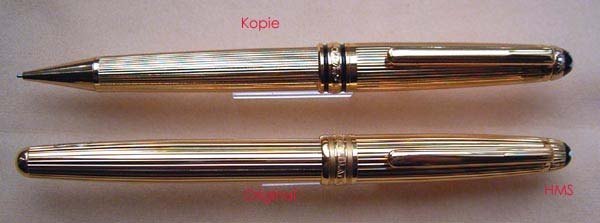
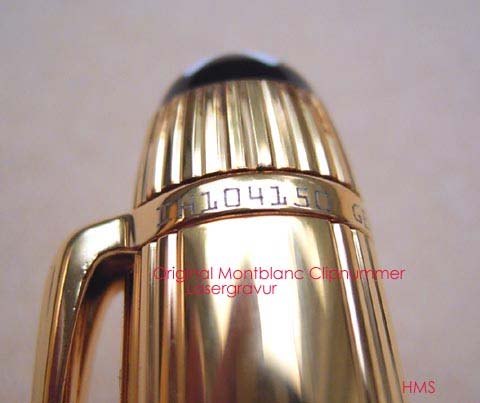
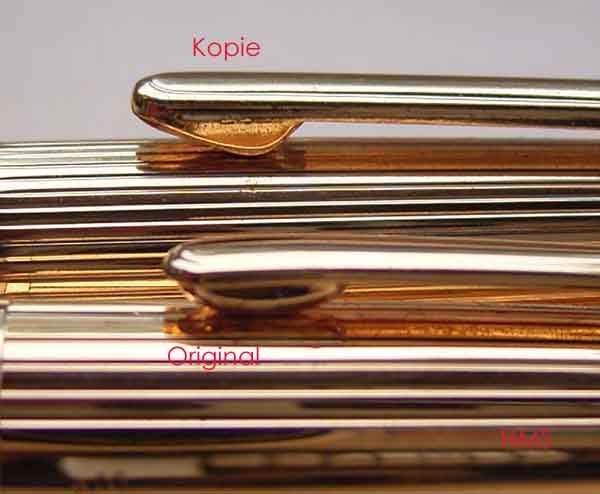
With the Solitaire copies some of the discrepancies are so crude that they can be spotted even in mediocre seller photographs. That sets this case apart from many other fakes.
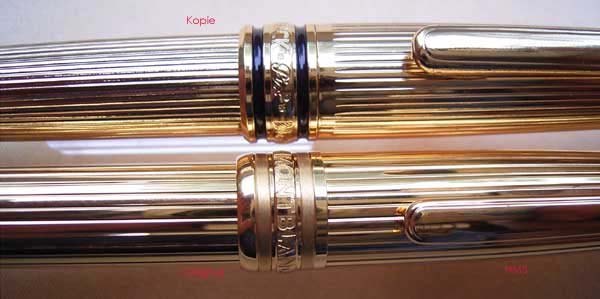
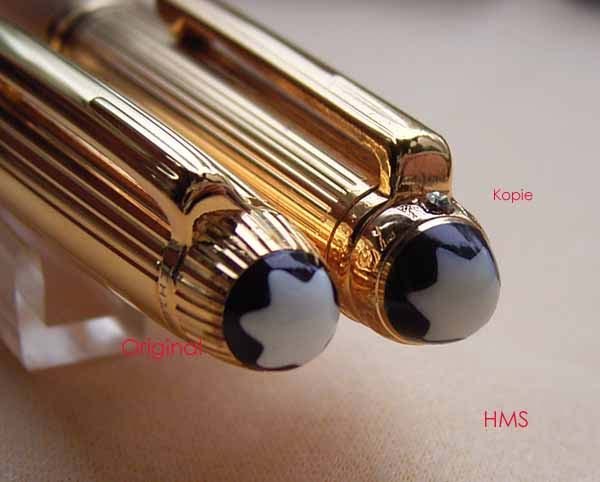
Look first at the cap rings: on the copy they are broken up by black rings, and the guilloché pattern is spaced noticeably more tightly than on the original. The cap star of the copy is pointed rather than round at the corners and looks less white. The clip is angular on the copy and rounded on the original. One further feature that is not always shown: on copies the cap top is often entirely black, as on a precious resin pen — Solitaire models always have a different treatment there.
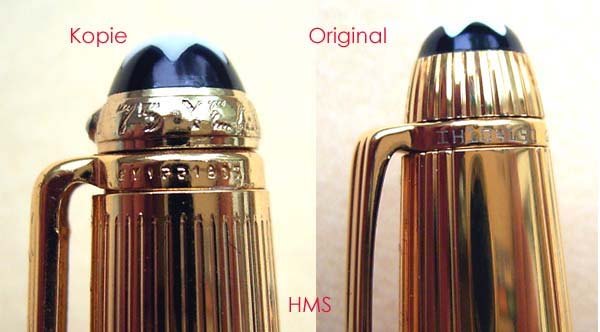
The clip serial number is decisive. On the original it is burned in with a laser and therefore appears grey; on the copy it is stamped, in other words pressed in. Any marking that looks pressed in belongs to a fake.
Seen from the side, the most serious difference lies in what is known as the clip ball: on the original it is a separate part, soldered on. On the copy, clip and ball are bent from a single piece of sheet metal, so that there is hardly any ball shape to speak of.